
What Ships With a Custom Jewelry Order
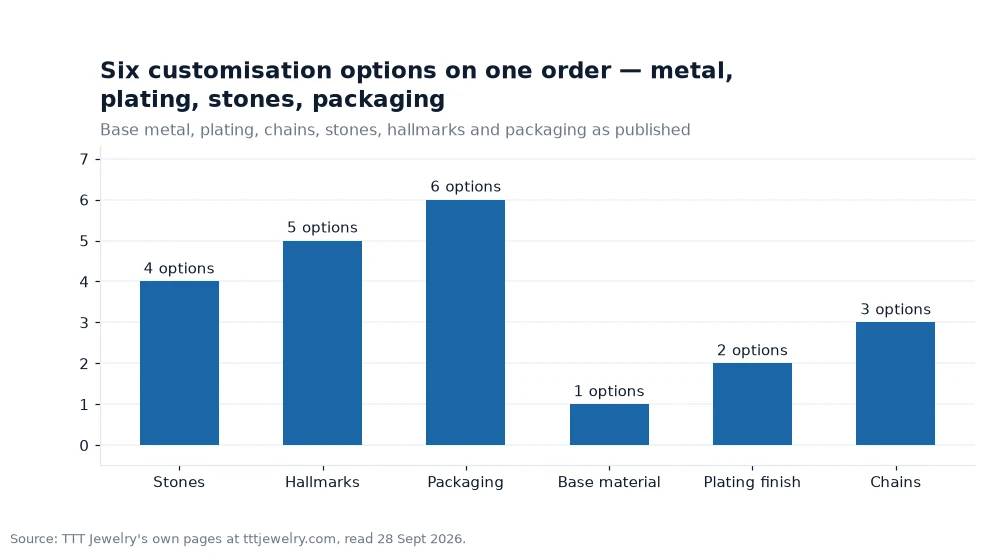
A custom order ships with more than metal. Six customisation fields are settled before production ends — base material, plating and finish, chains and findings, stones and accents, hallmarks and engraving, and packaging — and the last of them decides what a customer actually opens. On this route, final quality control inspects 100% of the pieces before any of it is packed.

Key takeaways
- Six customisation fields are available per order, from base material through plating, chains, stones, hallmarks and packaging.
- Packaging options include gift boxes with foil stamping, bar-coded labelling, pouches in velvet or microfiber, display cards with backing and metallic logo tags.
- Hallmarks are applied by laser engraving, using the a 316L mark on steel, an 18KGP mark on plated work and S925 on silver purity marks.
- Final QC at 100% inspection happens after electroplating and before packing, so nothing ships uninspected.
What is actually in a custom order
Start with the metal, because it decides the rest. A stainless steel, eco-brass and 925 silver piece is finished by PVD vacuum plating instead. That is one decision with three different manufacturing consequences.
Then add what hangs off the piece. Chains and findings are a separate field, and stones and accents, including natural stones and freshwater pearls, are another. Each one adds bench work and each one is specified before production rather than during it.
Three base materials share one route. An OEM/ODM order that arrives with a finished design still passes through the same six fields, because packaging, hallmarks and coatings are chosen after the geometry is fixed, and TTT Jewelry publishes the field list as part of the same documentation set that names the minimums and the development windows.
Packaging is a manufacturing field, not an afterthought
Packaging sits in the same list as plating because it changes the last stage of the line. The published formats are microfiber or velvet pouches, gift boxes stamped in foil, metal logo tags, backing cards and labelling with barcodes, all assembled after the pieces have passed inspection.
Barcode labelling is the item buyers forget, and the one that delays a retail launch. Ask for the label format, the barcode standard and the carton layout in the same message as the packaging choice, so the pack-out is planned rather than improvised.
The six fields in one view
Read the table as a checklist for the enquiry. Every row is a decision that has to be made before the sampling window closes, because each one changes tooling, finishing or packing. The option lists behind all six rows are published in full, so a buyer who wants the source rather than a summary can visit our website and compare the list against this page.
| Field | Published options | Where it is decided |
|---|---|---|
| Base material | 925 sterling silver, brass, stainless steel | Before CAD, since it sets the minimum |
| Plating and finish | 14K / 18K / 24K gold, rhodium, anti-tarnish e-coating, PVD | Before sampling |
| Chains and findings | Specified by the buyer | With the design |
| Stones and accents | Natural stones, freshwater pearls | Before stone setting |
| Hallmarks and engraving | S925, 316L, 18KGP, laser engraving | Before final QC |
| Packaging | Gift boxes, pouches, cards, barcode labels | After inspection |
The document set that travels with the pieces
Three statements accompany a finished order. The first is the materials position: metals free from lead, cadmium and nickel, with the plating declared compliant with REACH and California Proposition 65. The second is the quality claim: a documented process under ISO 9001:2015, with final inspection at 100% of the order before packing. The third is the confidentiality position: a 100% NDA that keeps the moulds, the CAD files and the collection exclusive to the brand.
Ask for all three with the shipping documents rather than after the fact. A purchase order that names them is easier to hold a supplier to than a conversation that assumed them. Two of the three also carry numbers: the materials position covers lead, cadmium and nickel specifically rather than making a general statement, and the quality claim rests on a 100% inspection of the order before packing, which is a countable figure rather than an adjective.
Table stakes: what the eight steps deliver
concept and CAD design, prototyping through a mould or 3D printing, then sprue cutting to release the casting and gloss polishing, then textured surface art, electroplating to spec, final quality check and delivery. The shipment is the output of that sequence, which is why the packing stage sits last and why a late change to packaging is more disruptive than it looks.
Two of those steps also determine what a customer sees first. Surface art decides how the metal reads in daylight, and electroplating decides whether that reading survives a month of wear. Packaging decides only the first ten seconds, but those ten seconds are the ones the customer photographs, so the field earns its place on the list.
Worked example: how many variants six fields can produce
Take two of the six fields and count the combinations using only published options. Three base materials combined with four plating choices — 14K, 18K and 24K gold plus rhodium — gives 3 × 4 = 12 material-and-plating combinations for a single design before any stone, chain or hallmark is added.
Now check which of those combinations take a top coat. Silver and brass receive the anti-tarnish e-coating, so 2 ÷ 3 = 0.667, meaning about 67% of the base materials get that layer. Stainless steel takes PVD vacuum plating instead, so 1 ÷ 3 = 0.333, one material in three. The option lists are the manufacturer's; the multiplication is mine, and it is the reason a spec sheet beats a description when an order is placed.
Frequently asked questions
What can be customised on a jewelry order?
Six fields: base material, plating and finish, chains and findings, stones and accents, hallmarks and engraving, and packaging, each with a published option list.
When are hallmarks applied?
Before final inspection, using high-precision laser engraving: S925 for sterling silver, 316L for stainless steel and 18KGP for gold plated pieces.
Is packaging assembled before or after quality control?
After. Final QC inspects 100% of the order after electroplating and before packing, so pieces are boxed only once they have passed the last gate.
Specifying an order so nothing is left to chance
Write the six fields into the enquiry, attach the barcode format, and the sampling window becomes a confirmation exercise rather than a discovery one. A brand that names its material, its coating, its hallmarks and its packaging before the first email gets a sample that can be approved instead of discussed. Buyers who want the packing options compared line by line can check the source lists behind this page, while the piece types available in each material line are grouped under custom jewelry wholesale and the finishing behaviour of the hardest-wearing material is described under stainless steel jewelry.
Tracked back — production over 3–4 weeks / the 14K / 18K / 24K gold and rhodium plating list and the 100% checking rule — every one of them came from the maker's own site over at tttjewelry.com, read 28 Sept 2026. The day-and-week bookkeeping belongs to me rather than the client[1].